The Complete Guide to Action Titles (Like McKinsey)
We break down how McKinsey writes action titles, so you can turn your slide titles into the strongest part of your deck.
Published on 24 July 2026 by Daniel Galletta
Open any McKinsey, BCG or Bain deck and read only the slide titles. You'll notice something: the titles alone tell you the whole story. Each one is a full sentence with a point of view, and together they walk you through the argument without a single chart.
Those are action titles, and they're probably the highest-leverage writing habit we can steal from consulting. In this guide we'll cover what they are, what separates a strong one from a weak one, how they carry the storyline of an entire deck, and how to pressure-test our own before a deck goes out.
What an action title is
An action title is a slide title that states the key takeaway of the slide, the "so what", as a complete sentence.
Most slides in the corporate world carry label titles instead. A label title tells your stakeholders what the slide is about. An action title tells them what the slide means.
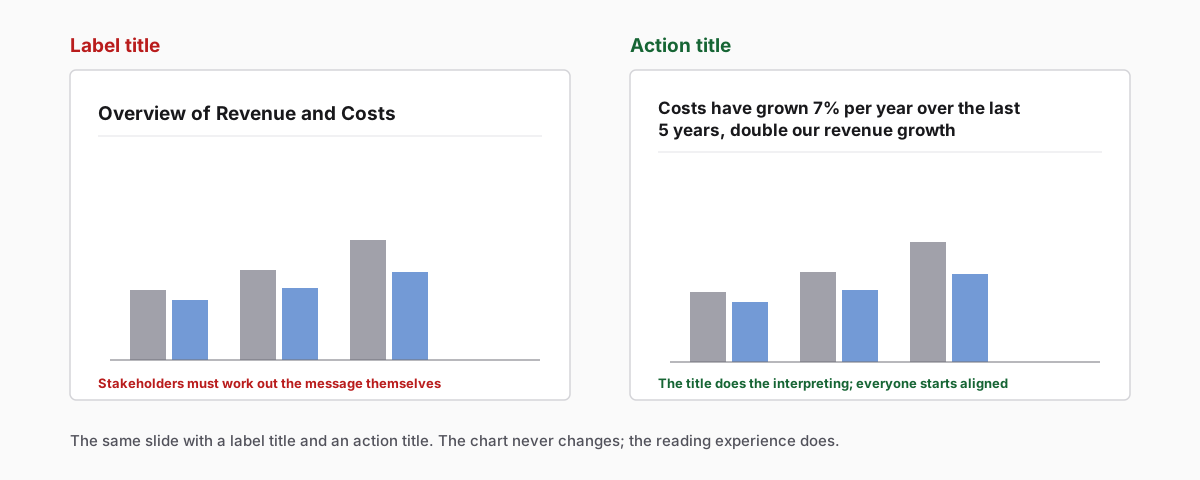
Same slide, same chart, two very different experiences:
- Label title: "Overview of Revenue and Costs"
- Action title: "Costs have grown 7% per year over the last 5 years, double our revenue growth"
With the label title, every executive in the room has to study the chart and work out the message themselves. Some of them will get there. Some will get somewhere else entirely, and now the meeting is about whose interpretation is right. The action title does the interpreting for them, which means everyone starts from the same message.
Why action titles work
Executives read slides the way we all read news: headline first, detail only if the headline earns it. When your stakeholders flip through a deck before a meeting, they're mostly reading titles.
There's a second benefit that matters just as much: writing action titles forces us to know what each slide is for. If we can't state a slide's takeaway as one sentence, the slide doesn't have one yet. Maybe it's two slides. Maybe it's an appendix page. Maybe it shouldn't exist. Consultants write titles first partly because it exposes these problems before anyone builds a chart.
The anatomy of a strong action title
A strong action title is a specific, quantified claim about an outcome, written in plain words.
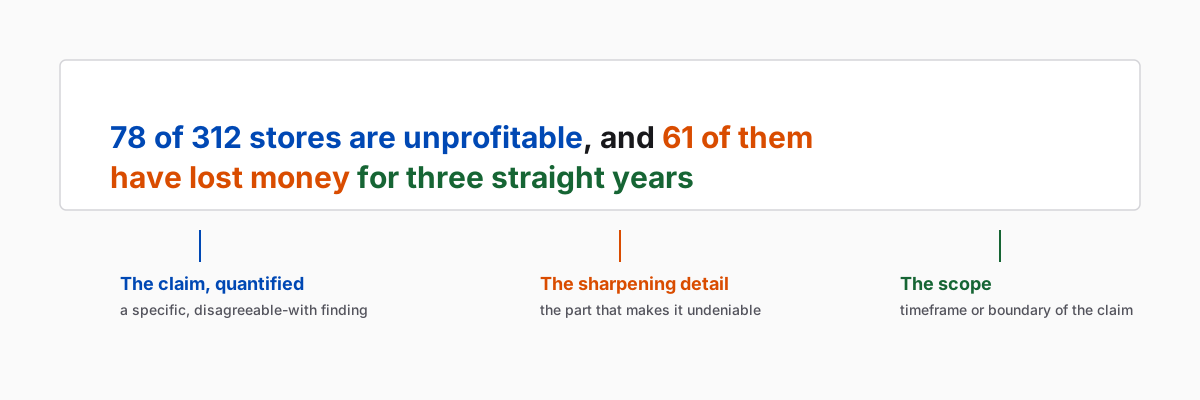
Five properties to aim for:
- It makes a claim. Your stakeholders should be able to agree or disagree with it. A description ("overview of costs") gives them nothing to react to.
- It's specific. "We see opportunities to improve efficiency" is technically a sentence, and it says nothing. If the title would be true for any company in any year, it's not done.
- It's quantified. A quantified claim is much harder to dismiss. "Costs are growing faster than revenue" is weaker than "costs have grown at double the rate of revenue since 2021."
- It reports an outcome rather than an activity. Stakeholders care about what we found, rather than what we did to find it. "We interviewed 13 customers about onboarding" is an activity. "Customers take three times longer to onboard with us than with competitors" is an outcome.
- It uses plain words. If a title needs jargon to sound impressive, the finding underneath is usually thin.
Here's how weak titles map to strong ones:
| Weak (label or vague) | Strong (action title) |
|---|---|
| Overview of Revenue and Costs | Costs have grown 7% per year since 2021, double our revenue growth |
| Customer Survey Results | Onboarding is our lowest-rated experience, scoring 4.1 vs a 7.8 category average |
| Market Trends | Online now takes 34% of category sales, and every point comes out of store revenue |
| Efficiency Opportunities | Automating invoice processing saves £2.1m per year at current volumes |
| Project Update | We're two weeks behind on data migration, and the go-live date is at risk |
Horizontal logic: your titles are the storyline
Strong individual titles are only half the job. The real McKinsey discipline is that the titles work together: read in sequence, they form the complete argument of the deck. Consultants call this horizontal logic, because the story flows horizontally across the tops of the slides.
Here's what that looks like for the deck behind our executive summary guide, a review of a retailer's store network:
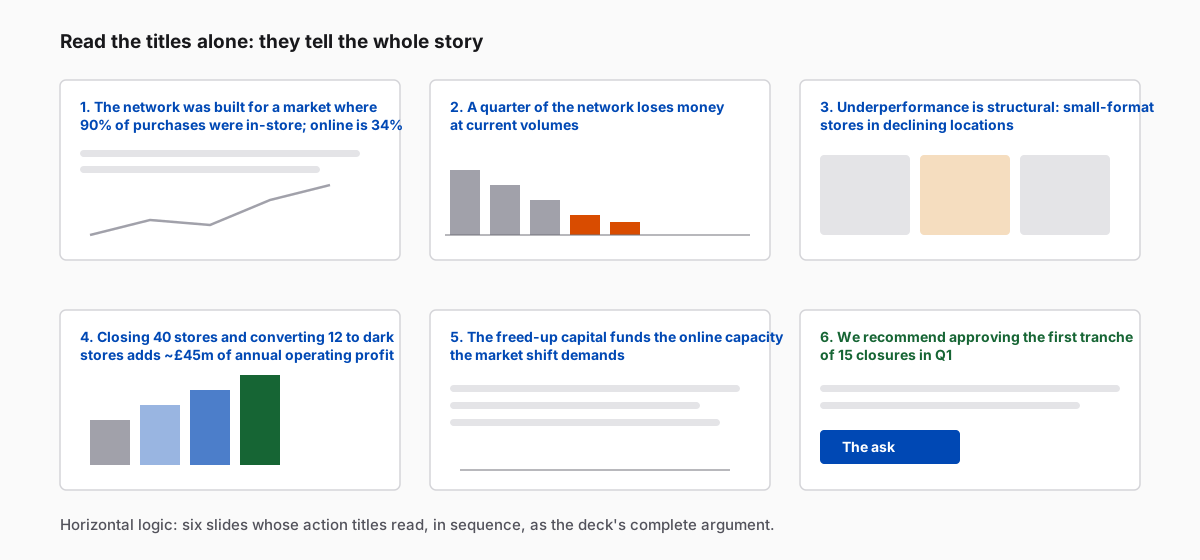
- The store network was built for a market where 90% of purchases happened in-store; online is now 34% and rising
- A quarter of the network loses money at current volumes
- Underperformance is structural: it concentrates in small-format stores in declining locations
- Closing 40 stores and converting 12 to dark stores adds around £45m of annual operating profit
- The freed-up capital funds the online capacity the market shift demands
- We recommend approving the first tranche of 15 closures in Q1
Read the titles alone and you have the whole argument. This is also the practical drafting method: write the titles first, as a storyboard, before building any slides. It takes an hour, it can be reviewed by a colleague in ten minutes, and it kills weak decks while they're still cheap to change. The finished storyboard then becomes your executive summary almost for free, since the summary is the same storyline compressed onto one slide.
Worked example: three passes on a weak title
Let's sharpen a real one. The starting point, from a slide showing store profitability data:
Store performance analysis
Pass 1: make it a claim. What did the analysis actually find?
Many stores in the network are unprofitable
Pass 2: quantify it. How many is many? How unprofitable?
78 of our 312 stores are unprofitable after allocated costs
Pass 3: scope it and add the so-what. Over what period, and why does it matter?
78 of 312 stores are unprofitable, and 61 of them have lost money for three straight years
Each pass asks one question of the analysis. If the analysis can't answer the question, the work isn't finished yet. Sharp titles have a way of auditing the thinking behind them.
The three title levels in a McKinsey deck
Action titles sit inside a small hierarchy, and keeping the levels straight avoids a common mess:
- The deck title. The overall recommendation or question, on the cover.
- Section trackers. Short labels ("Where we are today", "The opportunity") that mark the deck's chapters, often shown as a small navigation bar. These are allowed to be labels, because their job is to help stakeholders navigate the deck.
- Action titles. Every content slide gets one, and it carries that slide's takeaway.
The mess happens when trackers and action titles blur: content slides titled "Current state" tell your stakeholders nothing, and tracker pages carrying full arguments belong in the body.
When action titles are the wrong tool
Action titles are the right default for any deck that gets read: board papers, steering committees, strategy reviews, project updates. There are honest exceptions.
- Stage presentations. If the deck is a backdrop while you talk, keynote-style, long sentence titles compete with your voice. Short titles or none at all work better there. The test: will this deck be read without me in the room? If yes, action titles.
- "Aren't they too long?" A fair objection with a real answer: an action title should still fit on two lines at most. If it doesn't, the title is trying to carry the whole slide body. State the claim in the title, put the qualifications in the body.
- "My boss doesn't like them." It happens, and some organizations genuinely prefer label titles. One practical middle ground is a short label title with the takeaway as a bold lead-in line at the top of the body. The takeaway still gets stated; only its position moves.
Seven checks before your deck goes out
Run these against your titles the way a McKinsey reviewer would:
- Sentence check. Is every content-slide title a complete sentence with a verb?
- Claim check. Could a stakeholder disagree with each title? If not, it's a label.
- Number check. Do the titles that rest on analysis carry the key number?
- Story check. Read all titles in order. Do they form a complete, logical argument?
- Overlap check. Do any two titles say the same thing? If so, one slide probably goes.
- Support check. Does each slide's body actually prove its title? A title the body can't back up is the fastest way to lose the room.
- Sync check. Do the titles agree with the executive summary, down to the numbers?
The support and sync checks are where careful people get caught, because titles get sharpened late at night and the body slides quietly fall out of step. This is part of what we're building SlideBrain to catch: it reads your deck inside PowerPoint and flags titles that don't match their slide's content, titles that break the storyline, and numbers that disagree between slides.
For inspiration from the real thing, slidescience's action titles guide shows examples from actual McKinsey, BCG, Bain and Oliver Wyman slides. The section headers in the real consulting proposals we collected are worth reading the same way.
FAQ
What are action titles in PowerPoint? Slide titles written as complete sentences that state the slide's key takeaway, rather than describing its topic. "Costs have grown at double the rate of revenue since 2021" is an action title; "Cost overview" is a label.
What is an example of an action title? Weak: "Customer Survey Results". Strong: "Onboarding is our lowest-rated experience, scoring 4.1 against a 7.8 category average". The strong version states the finding, with the number, so stakeholders get the message without decoding the chart.
How do I create action titles? Ask three questions of each slide: what's the claim, what's the number, and what's the timeframe or scope? If the slide can't answer, the analysis isn't finished. For a new deck, write all the titles first as a storyboard and check they read as a story before building anything.
Do action titles break the 5/5/5 rule? The 5/5/5 rule is about body text on slides that get presented live. A reading deck uses full-sentence titles deliberately, because they're what executives actually read. Keep titles to two lines at most and the density takes care of itself.