25 Real Consulting Proposals From McKinsey, BCG & More
We collected 25 real consulting proposals from McKinsey, BCG, Deloitte and more, so you can see exactly how the top firms pitch and win work.
Published on 24 July 2026 by Daniel Galletta
Consulting proposals are some of the most closely guarded documents in the business world. The firms invest enormous effort in them, they decide millions in fees, and they almost never leave the client's building.
However, when a consulting firm pitches a government agency, a public university or a regulated body, the proposal often becomes a public record. Procurement transparency portals and freedom-of-information disclosures have quietly built a library of the real thing, and we've collected 25 of them here: McKinsey, BCG, Deloitte, EY-Parthenon, KPMG, PwC, Accenture and Strategy&, every one a genuine proposal the firm actually submitted, every link pointing to the public source.
What is a consulting proposal
A consulting proposal is the document a firm submits to win an engagement. It's how consulting work gets sold: the client describes a problem, sometimes informally over a series of conversations, sometimes formally through a request for proposal (an RFP), and the firm responds with a document that says here is how we understand your problem, here is how we'd solve it, here is the team, and here is the price.
The stakes make these documents unusually good. A proposal is often the only work product the client sees before deciding whether to spend hundreds of thousands or millions on a firm, so the document itself has to demonstrate the quality of the firm's thinking. That's why they're worth reading even if you never hire or work for a consultancy: each one is a worked example of persuading a skeptical executive audience to make an expensive decision.
What's inside a real consulting proposal
Before we get to the collection, it helps to know what we're looking at. Nearly all 25 documents follow the same six-part structure:
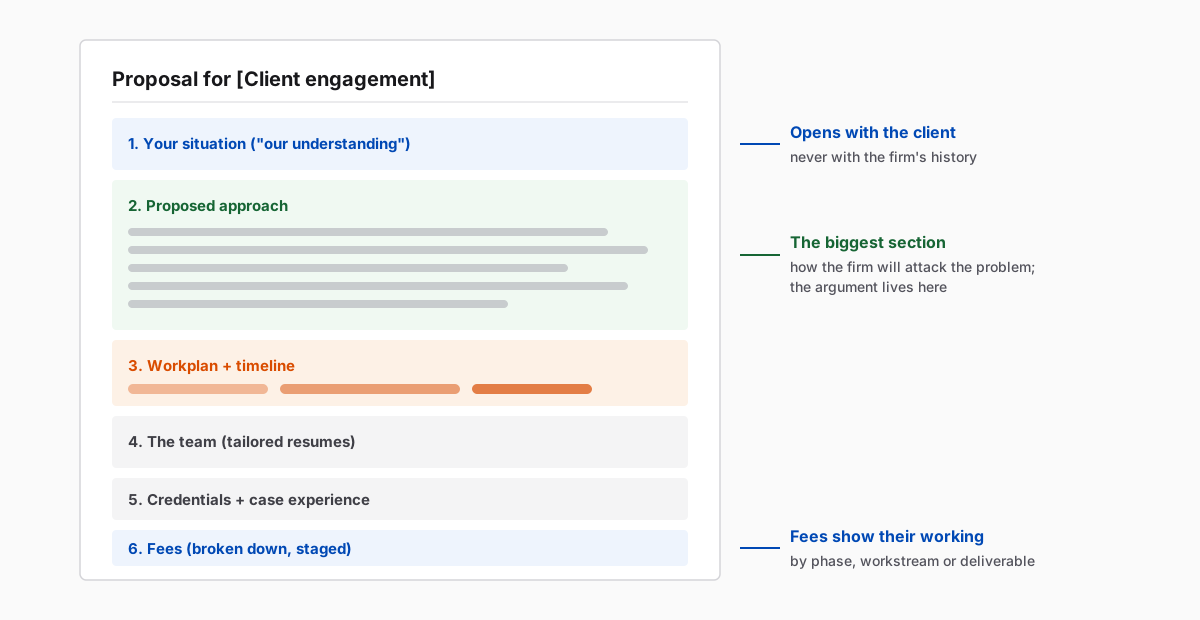
- The client's situation. Every strong proposal opens with the client's world ("our understanding of your challenge"), demonstrating that the firm has done its homework before asking for money.
- The proposed approach. The heart of the document: how the firm will attack the problem, usually phased, usually with a framework holding it together. This section gets more pages than anything else.
- Workplan and timeline. Phases, workstreams, activities and deliverables, mapped to weeks. The good ones make a complex project feel inevitable.
- The team. Named people with tailored resumes. The strong versions argue why each person fits this project, rather than listing generic credentials.
- Credentials and case experience. Proof the firm has solved this problem before, selected to match the client's situation.
- Fees. Always structured: by phase, by workstream, or by deliverable, often with rate cards. The number reads as calculated because the breakdown shows the calculation.
You'll recognize the storyline logic here: situation, complication, resolution, the same SCR structure that drives executive summary slides, stretched across a full document.
McKinsey proposals
1. Organizational review of Military & Veterans Affairs, State of New Jersey
A winning proposal to review two cabinet-level state agencies over 24 weeks. Worth studying for the workplan: a genuinely complex engagement laid out on a timeline that stays readable, and team resumes that argue fit rather than list degrees.
2. Organizational development and change management, Washington State
A bid for a standing consulting arrangement with the Department of Enterprise Services. Worth studying for how fairly generic service descriptions (strategic planning, leadership development) are written to feel specific and tailored.
3. COVID-19 response support, New Jersey EDA
An extension proposal written at pandemic speed for 12 more weeks of work. Worth studying for workstream discipline: each workstream gets objectives, activities and deliverables, and the fee is broken down by workstream, team size and duration.
4. Distributive Energy Resources program, NJ Board of Public Utilities
A full technical quote disclosed through New Jersey's Sandy transparency program. Worth studying as the full-scale version: this is what a complete technical response to a government RFQ looks like, cover letter to appendices.
5. Louisiana government efficiency cost proposal
The cost proposal for an 11-week government efficiency engagement. Worth studying for the money pages: costs broken down by deliverable and by hourly rates, plus how a project this size gets coordinated through a program management office.
6. West Virginia Governor's office proposal
A proposal with a story attached: McKinsey faxed it in, it arrived late, and the state stamped it BID RECEIVED LATE, DISQUALIFIED, both stamps visible on the cover sheet. Worth studying as a complete recent McKinsey proposal, and as proof that process discipline fails even the best firms.
BCG proposals
7. Low-carbon energy roadmap for a New Zealand energy consortium
Context, proposed solution, objectives, scope and timeline in eleven pages. Worth studying as the short-form counterexample. When the relationship is warm and the problem is clear, this is how little a proposal needs.
8. Procurement spend analysis, Commonwealth of Virginia
A detailed RFP response for procurement transformation. Worth studying for the fee structure, which puts BCG's money where its analysis is, and for how sector-wide challenges get contrasted with client-specific findings to demonstrate expertise.
9. Planning free community college, Massachusetts
A proposal for planning the MassEducate rollout. Worth studying for how a policy engagement gets scoped, and for the confidentiality language that shows how hard firms try to keep these documents out of public view.
10. Geospatial data strategy, UK Government Investments
Disclosed under UK freedom-of-information rules. Worth studying for a methodology-forward structure: most of the document explains how BCG would think, because for exploratory work the method is the product.
Deloitte proposals
11. Efficiency and Transformation Review, Iowa Board of Regents
A system-wide review of Iowa's public universities. Worth studying for how a large transformation proposal is organized so evaluators can actually navigate it.
12. Hurricane Sandy recovery support, New Jersey
A technical proposal for disaster-recovery program management. Worth studying for the volume structure government RFPs demand, and for proposing into a crisis where speed and credibility carry the argument.
13. Medicaid waiver consulting, Georgia DCH (the bake-off winner)
The winning response in the Georgia bake-off below. Worth studying for how a firm turns incumbency into an argument: named Georgia-specific staff and program knowledge on nearly every page.
EY and EY-Parthenon proposals
14. Board of Regents strategic plan, Iowa (EY-Parthenon)
A response for developing a five-year strategic plan. Worth studying as a pure strategy proposal from a strategy house: the approach section reads like a storyline of hypotheses rather than a list of tasks.
15. Higher education needs assessment, Des Moines (EY-Parthenon)
The sibling document on assessing regional education needs. Worth studying for the analysis plan, which shows how a firm structures market research before any research exists.
16. Airport lease advisory, City of St. Louis
Advisory services for the potential lease of Lambert International Airport. Worth studying as deal-advisory proposing: concise, fee-forward, credentials doing the heavy lifting.
17. Integrity oversight monitor, New Jersey Treasury
A "proposal to serve" for Sandy-recovery integrity monitoring. Worth studying for the compact format firms use when responding to a pre-qualified pool rather than an open RFP.
18. Medicaid waiver consulting, Georgia DCH
EY's entry in the Georgia bake-off below. Worth studying as the leaner take on the same brief the other three answered.
KPMG proposals
19. Enterprise security assessment, Pennsylvania Treasury
A redacted advisory proposal. Worth studying for engagement scoping, and the redactions themselves are instructive: what got blacked out is what firms consider competitively sensitive.
20. Anti-fraud monitoring, Middlesex County Utility Authority
A "proposal to serve" for integrity oversight. Worth studying alongside EY's version of the same format (#17) to see two firms answering near-identical briefs.
21. Medicaid waiver consulting, Georgia DCH
The shortest of the four Georgia bake-off responses. Worth studying for what gets cut when a firm goes minimal on a formal RFP.
PwC proposals
22. Sandy disaster recovery program management, New Jersey
A response covering three service pools, including the best-and-final-offer price schedule. Worth studying for exactly that: you rarely get to see how a firm revises its own pricing under competitive pressure.
Accenture proposals
23. Eligibility and enrollment tracking, Washington State DSHS
A complete bid package. Worth studying to see everything that surrounds the persuasive core in a big public-sector bid: certifications, forms, compliance matrices. The proposal is a fraction of the paper.
24. Medicaid waiver consulting, Georgia DCH
The longest response in the Georgia bake-off, and it lost. Worth studying next to Deloitte's winner (#13) to see why volume alone doesn't carry an evaluation.
Strategy& proposals
25. Commercialization strategy, Collexis Holdings (Booz & Company)
A Booz & Company (now Strategy&) letter proposal that surfaced in an SEC filing: understanding of the situation, scope questions, approach, team and fee, all in a few pages. Worth studying as the rare private-sector artifact, and as the letter format firms use with corporate clients when nobody demands volumes.
Same brief, four answers: the Georgia bake-off
In May 2019, Georgia's Department of Community Health asked for proposals on Medicaid waiver consulting, and the state later published four competing responses to the identical brief: Deloitte (#13), EY (#18), KPMG (#21) and Accenture (#24).
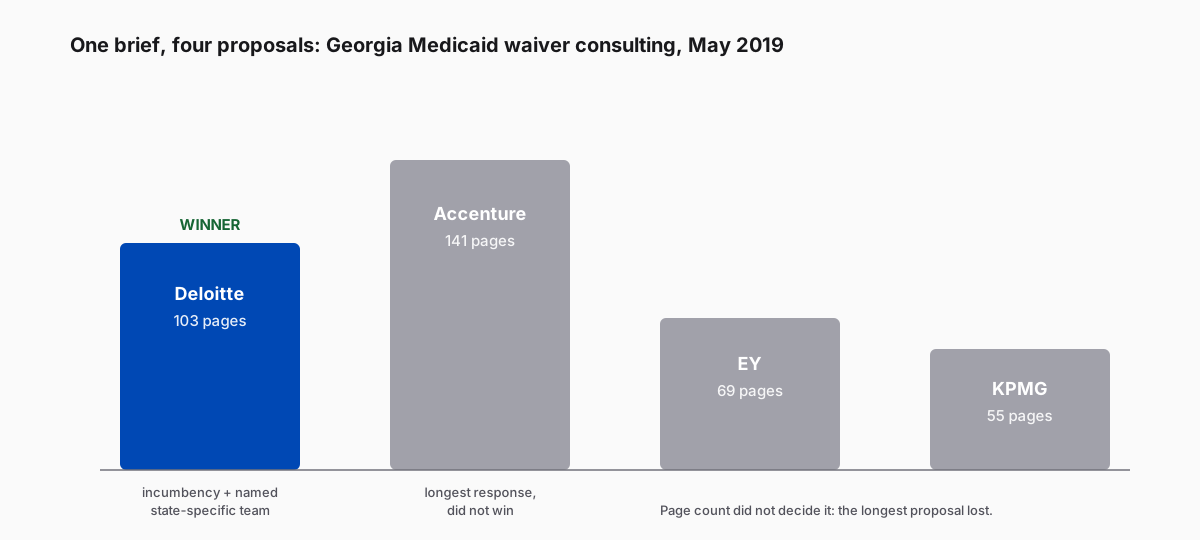
Reading them side by side is a masterclass. The page counts alone tell you length didn't decide it: Accenture wrote the most and lost. Deloitte won on the fundamentals: its response shows the deepest understanding of Georgia's actual problem, backs it with the most directly relevant experience (years inside the state's programs, with named staff who had worked on them), and lays out the most convincing approach to getting the waivers designed and approved. The other responses spend proportionally more space on generic credentials. If you only read one set of documents from this whole collection, read these four with the question "which would I pick?" and then check your reasoning against the outcome.
Five patterns across all consulting proposals
Reading the collection end to end, the same habits keep appearing:
- They open with the client, never the firm. Every strong proposal starts with "here's your situation, and here's what we understand about it." Firm history, if it appears at all, comes late and short.
- The approach section carries the page count. Just as the resolution earns most of an executive summary slide, the how-we'll-solve-it section dominates these documents.
- Everything is staged. Phases, workstreams, decision gates, fee tranches. Staging makes a big commitment feel like a series of small, reversible ones.
- Team pages are arguments. The resumes are tailored to the engagement, and the strong proposals say explicitly why this person for this workstream.
- Fees show their working. By deliverable, by workstream, by rate card. A number with a visible breakdown invites negotiation on components; a bare number invites rejection.
Using these in your own proposals
Steal structure, never paragraphs. The six-part anatomy travels to any proposal you'll ever write, consulting or otherwise: open with their situation, spend your pages on the approach, stage the work, argue the team, prove you've done it before, and break down the number.
Two of our other guides pair well here: write the section headers of your proposal as action titles so the document skims like an argument, and compress the whole storyline into a one-page executive summary up front, which several of the 25 do.
And when the proposal becomes a deck, the same review discipline applies: claims backed by evidence, numbers that agree across pages, titles that tell the story. That's the checking we're building SlideBrain to do inside PowerPoint.
FAQ
How do I write a consulting proposal? Follow the structure the real ones share: the client's situation, your proposed approach (the biggest section), a staged workplan with a timeline, the team and why they fit, relevant case experience, and a fee breakdown that shows its working. Draft the situation and approach first; everything else supports them.
What does a real McKinsey proposal look like? Six of them are linked above. In general: a clear storyline structure, a framework-driven approach, workstreams with objectives and deliverables, tailored team resumes, and fees broken down by workstream or deliverable.
Is there a McKinsey proposal template? No official one exists, and the firm's proposals vary by client and situation. The closest thing to a template is the shared six-part anatomy above, which you can apply directly, with the real documents as worked examples.
How long should a consulting proposal be? The collection runs from a few pages (the Booz letter proposal, BCG's 11-page roadmap proposal) to 286 pages (Accenture's full bid package). Match the client's process: warm relationship and clear scope means short; formal RFP means every required volume. Length didn't decide the Georgia bake-off, and Accenture's 141 pages lost to Deloitte's 103.