How to Write Executive Summary Slides (Like McKinsey)
We break down exactly how McKinsey, BCG and Bain write executive summary slides, so you can write one yourself with confidence.
Published on 24 July 2026 by Daniel Galletta
For most decks, the executive summary is the only slide senior people actually read. They'll skim it in the elevator, in the five minutes before your meeting, or while half-listening on a call. If it holds up, you get the meeting you wanted. If it fails, the ninety slides behind it never get a chance.
Consulting firms know this. At McKinsey, BCG and Bain, teams spend an enormous amount of time on this one slide, and their executive summaries all follow the same recognizable pattern. In this guide we'll learn that pattern, walk through rewriting a weak executive summary step by step, and finish with a checklist we can run on our own slides before hitting send.
What an executive summary slide is
An executive summary slide is the first content slide of a deck. It summarizes the complete argument on a single slide: the context, the problem, and our recommendation, together with the key supporting evidence. Long decks sometimes use two slides, but one is the norm.
It does three jobs:
- It's the decision surface. Many executives will decide based on this slide alone, so it has to work by itself.
- It's a map. Stakeholders who do go through the body slides use the summary to keep track of the overall argument.
- It's a forcing function. If we can't summarize the deck on one slide, the deck usually doesn't have a clear storyline yet. Writing the summary exposes that problem early, while it's still cheap to fix.
That third job is why experienced deck-writers at the top firms often draft the executive summary first, as a hypothesis of the storyline, and then keep it updated as the analysis firms up. The common alternative, writing it once at midnight after everything else is finished, is where bad summaries come from. Most of us have been there.
The structure: situation, complication, resolution
McKinsey-style executive summaries follow a storyline structure called SCR, which stands for situation, complication, resolution. The whole structure fits on one slide.
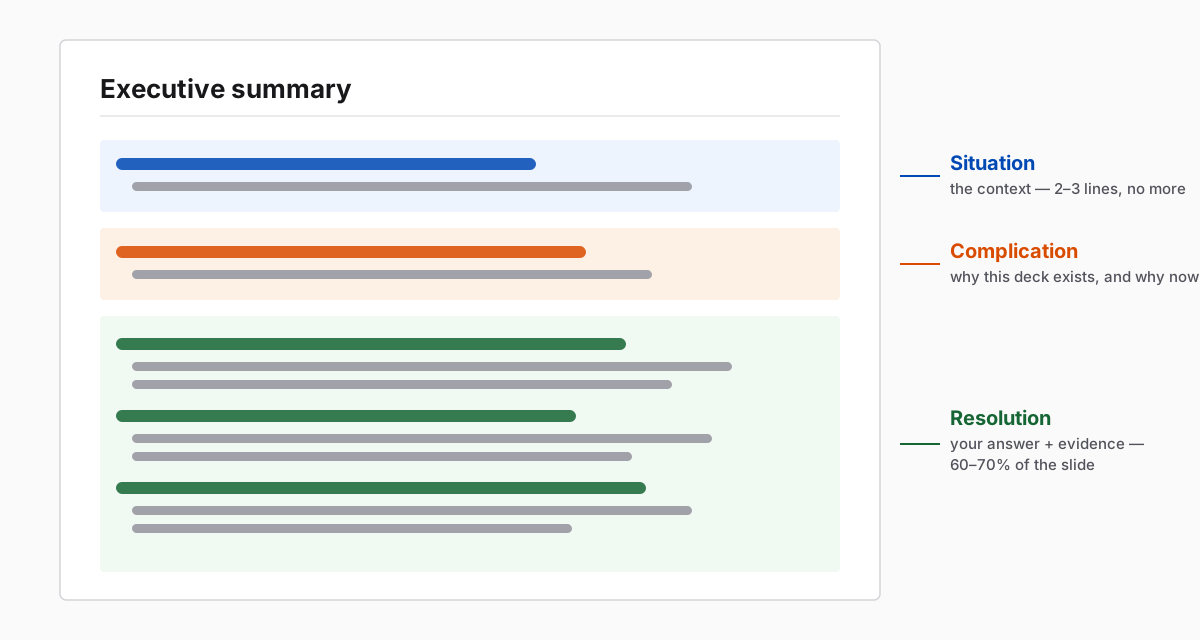
- Situation. The context our stakeholders need before the argument makes sense. What's true about the business or market that everyone can agree on? Keep it to two or three lines. If our stakeholders live in this context every day, one line is enough.
- Complication. The problem or opportunity that makes this deck necessary, and why it matters now. Also short. A good complication makes our stakeholders want to hear the answer.
- Resolution. Our answer: the recommendation, the reasoning, and the key evidence. This is the part our stakeholders came for, and it earns 60 to 70 percent of the slide.
The proportions are the part people get wrong most often. Weak executive summaries spend half the slide proving the author did a lot of background work. Strong ones spend that space on what should happen next and why.
Bold text for claims, bullets for evidence
The visual signature of a consulting executive summary is the bold-bullet structure. Bolded sentences state the claims. Under each bold sentence, indented bullet points carry the supporting data.
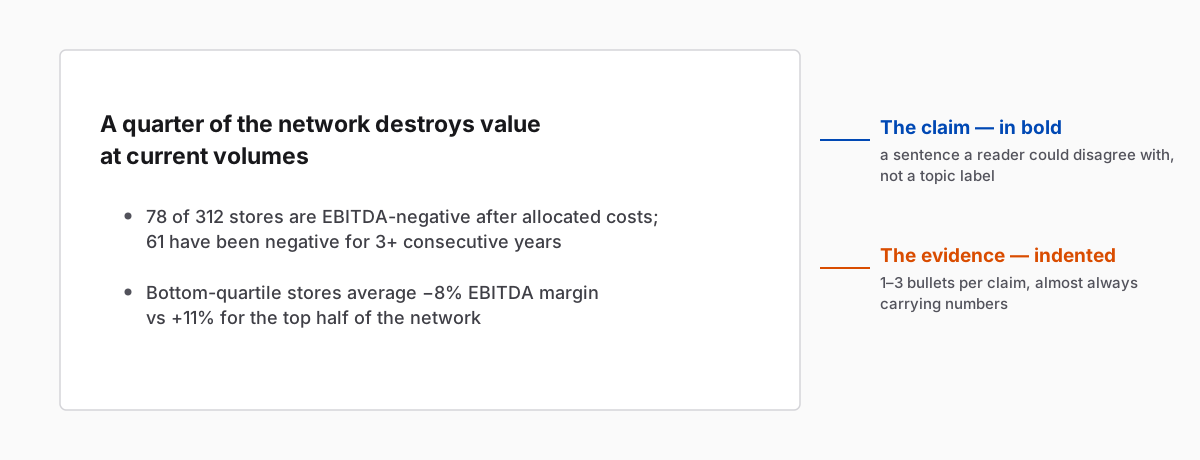
Two rules make this structure work:
- Every bold sentence makes a claim. "Store network performance" is a topic label. "A quarter of the store network loses money at current volumes" is a claim. A claim is something an executive stakeholder could agree or disagree with, and that's what turns a slide into an argument.
- No claim without evidence. Each bold claim gets one to three bullets of support, almost always with numbers. If we can't put evidence under a claim, either the analysis isn't finished or the claim doesn't belong on the slide.
The structure exists because of how executives actually read. They scan the bold text, and they drop into the bullets only where they feel skeptical.
The skim test
Read only your bold sentences, in order, out loud. They must tell the complete story on their own.
If the bold sentences alone read as a coherent narrative, with context, problem and answer, the slide works, because that's exactly how our busiest executive will consume it. If they read as a list of disconnected observations, no amount of formatting will save the slide.
This edit takes thirty seconds and catches more problems than anything else we can do to the slide.
Worked example: rewriting a weak executive summary
Although the structure is easy to describe, it's harder to apply, so let's walk through a full rewrite. The scenario: a retailer asked for a review of its store network, and the team's recommendation is to close 40 stores and reinvest in "dark stores", which are small warehouses that serve online orders.
Here's the first draft:
Executive summary
- Project background and approach: 12-week review of the store network, covering 312 stores across all regions
- Store visits and management interviews were conducted across 45 locations
- Retail market trends: online penetration continues to grow across all categories
- Analysis of store-level P&Ls shows performance varies significantly by location
- Some stores are underperforming and options should be considered
- Next steps: align on approach and develop implementation plan
Everything on this slide is true, and it says nothing. It describes the work instead of the findings. Its statements are topics rather than claims. There's no evidence attached to anything. And the recommendation, which is the entire point of the deck, is hiding inside "options should be considered."
Let's fix it in four passes.
Pass 1: impose the storyline. We ask three questions. What's the situation, what's the complication, what's our answer? Then we strip everything that serves none of the three. The project background, the methodology and the interview count all move to the appendix.
Pass 2: turn topics into claims. Every line becomes a sentence someone could disagree with:
The store network was built for a market where 90% of purchases happened in-store; online is now 34% and rising. A quarter of the network loses money at current volumes. Closing 40 stores and converting 12 to dark stores adds around £45m of annual operating profit within two years.
Pass 3: attach the evidence. Each claim gets its supporting bullets:
A quarter of the network loses money at current volumes.
- 78 of 312 stores are unprofitable after allocated costs, and 61 of them have been unprofitable for three or more consecutive years
- The weakest quarter of stores average an 8% operating loss, while the top half of the network averages an 11% profit margin
Pass 4: run the skim test. Reading the bold sentences alone:
The store network was built for a market where 90% of purchases happened in-store; online is now 34% and rising. A quarter of the network loses money at current volumes, and the causes are structural: location and format, not management. Closing 40 stores and converting 12 to dark stores adds around £45m of annual operating profit within two years, funding the online capacity the market shift demands. We recommend board approval to begin the first tranche of 15 closures in Q1.
Context, problem, answer, action, readable in fifteen seconds.
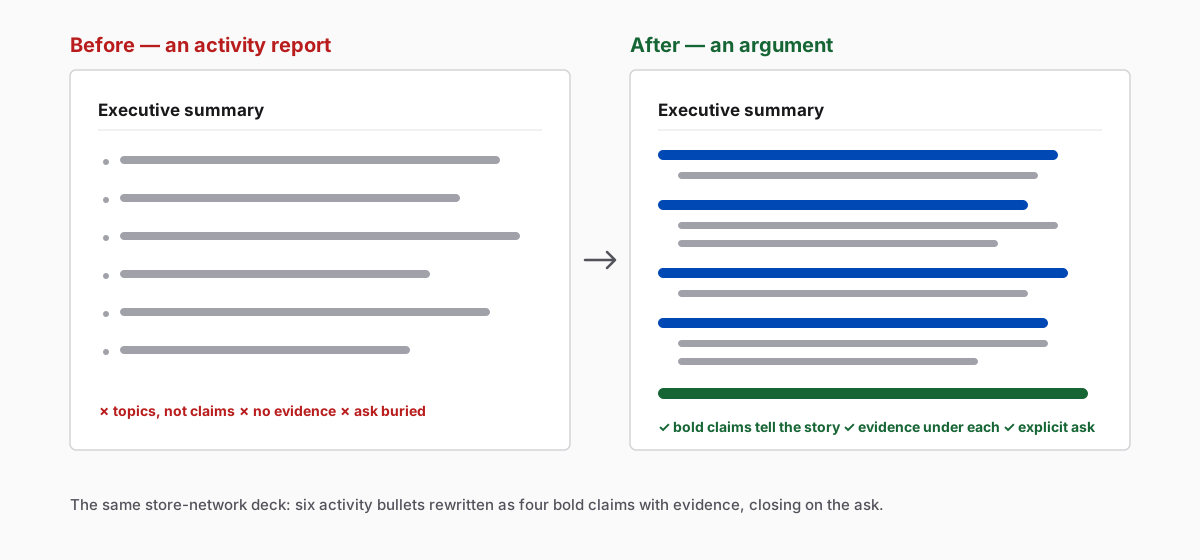
The difference between the two versions has nothing to do with writing talent. It's four mechanical passes, applied in order. For real examples of the finished form from BCG, Bain and other firms, slidescience's teardown of a BCG executive summary walks through the actual slides. And several of the 25 real consulting proposals we collected open with exactly this kind of one-page summary.
When to deviate from the standard form
The SCR summary is our default, and there are three situations where we should deviate:
- Answer-first. When the audience already agrees there's a problem, or has seen an earlier readout, leading them through situation and complication again wastes their time. Open with the recommendation and compress the supporting logic below it. Update meetings and steering committees usually want this form. Consultants sometimes call it RSC, since the resolution moves to the front.
- One slide or two. Stay on one slide until the evidence genuinely can't fit. A two-slide summary is legitimate for a recommendation deck of 100+ slides. If we use two, the first slide carries the argument and the second carries the recommendation detail: costs, timeline, and what we're asking for.
- Update decks. Progress updates have no complication and resolution arc. Use the equivalent structure: where we are, what's changed since last time, and what we need from you. The bold-bullet mechanics and the skim test still apply.
Eight checks before you send it
Before a deck leaves a consulting team, a senior reviewer reads the summary looking for the weak plank. Let's run the same checks on our own slide before sending it:
- Skim test. Do the bold sentences alone tell the complete story?
- Claim test. Is every bold sentence something a stakeholder could disagree with?
- Evidence test. Does every claim have data under it?
- Proportion test. Does the resolution get at least 60% of the slide?
- So-what test. Does the complication make our stakeholders need the resolution?
- Standalone test. Could someone who'll never see the body slides act on this one?
- Ask test. Is the specific decision or action we want stated explicitly at the end?
- Sync test. Does every claim on the summary appear in the body slides with the same numbers?
The last one catches more people than any other. The summary gets rewritten at midnight, the body slides don't, and the first sharp-eyed executive finds the £45m on slide 1 that reads £38m on slide 14.
This class of problem is what we're building SlideBrain for. It reads your deck inside PowerPoint and flags what a good reviewer would: bold sentences that don't tell a story, claims with no evidence, and numbers that disagree across slides. The checklist above is the manual version.
FAQ
What should an executive summary slide include? Context (situation), the problem or opportunity (complication), and your recommendation with key evidence (resolution), with most of the space on the recommendation. End with an explicit ask: the decision or action you want.
What about the "five parts of an executive summary"? The five-part templates (objective, situation, complication, resolution, call to action) are expansions of SCR. They're useful as a drafting scaffold. On the slide itself, situation, complication and resolution plus a clear ask covers all five.
Does the 5/5/5 rule apply? Rules like "5 bullets of 5 words" exist to prevent walls of text on body slides that someone presents live. An executive summary is deliberately denser, because it's a reading document. Full sentences in the bold text are correct here. Let the skim test provide the discipline instead of a word count.
How long should it be? One slide, or two for very long recommendation decks. If it doesn't fit, the storyline isn't tight enough yet. Tighten the argument instead of shrinking the font.
Should I write it first or last? Draft it first, as a hypothesis of your storyline. Finalize it last, so it stays in sync with the body slides.